62 Death Idioms and Expressions
People talk about death in many ways. Some words are soft. Some words are funny. These words are called idioms and expressions. An idiom is a group of words with a special meaning. The meaning is not the same as the words. For example, a person may say someone has “passed away.” This means the person died. People use these phrases to speak in a calm and kind way.
Death idioms and expressions are part of daily speech. They are found in books, stories, and talks. They help people share hard ideas with simple words. Many of these phrases come from old stories and long habits. Some sound serious. Some sound light. In this article, we will look at common death idioms and expressions and see how people use them.
1. Pass Away
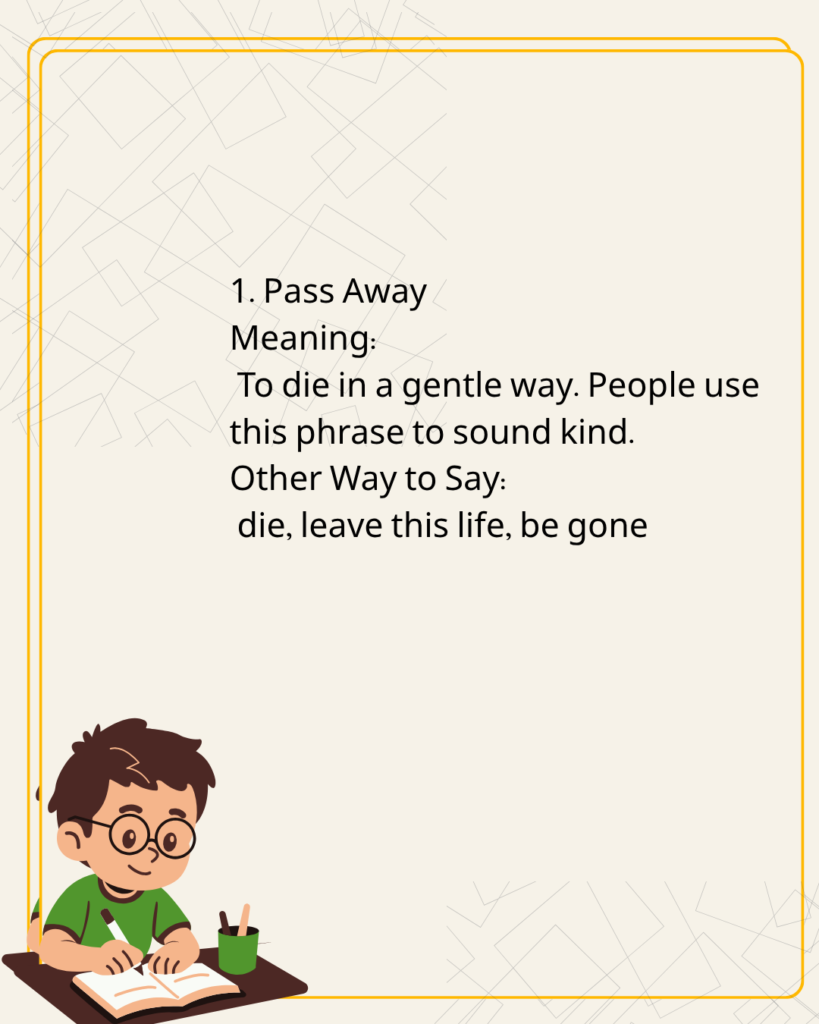
Meaning:
To die in a gentle way. People use this phrase to sound kind.
Other Way to Say:
die, leave this life, be gone
Alternative Meaning:
“My grandpa passed away last winter.”
“Our old dog passed away last night.”
“The news said the actor passed away at home.”
2. Rest in Peace
Meaning:
Words people say to hope a person rests after death.
Other Way to Say:
sleep in peace, rest well, be at peace
Alternative Meaning:
“People wrote ‘Rest in peace’ on the card.”
“The stone said ‘Rest in peace, Dad.’”
“We said rest in peace at the grave.”
3. Gone to Heaven
Meaning:
A soft way to say someone died and is now with God.
Other Way to Say:
went to heaven, with God, in heaven
Alternative Meaning:
“Mom said our cat has gone to heaven.”
“Grandma is gone to heaven now.”
“The child said his dog went to heaven.”
4. No Longer With Us
Meaning:
A polite way to say someone has died.
Other Way to Say:
passed on, gone, not here anymore
Alternative Meaning:
“My teacher said the writer is no longer with us.”
“The hero of the story is no longer with us.”
“Our old neighbor is no longer with us.”
5. Meet One’s Maker
Meaning:
To die and meet God.
Other Way to Say:
face God, go to heaven, see the creator
Alternative Meaning:
“The old cowboy met his maker in the story.”
“People say we all meet our maker one day.”
“The movie said the hero met his maker.”
6. Kick the Bucket
Meaning:
A funny way to say someone died.
Other Way to Say:
die, pass on, be gone
Alternative Meaning:
“The old pirate kicked the bucket in the tale.”
“The man in the movie kicked the bucket.”
“My uncle joked about kicking the bucket.”
7. Six Feet Under
Meaning:
A person is buried in the ground after death.
Other Way to Say:
in the grave, buried, laid to rest
Alternative Meaning:
“The villain ended up six feet under.”
“The show said the bad guy is six feet under.”
“The joke said he is six feet under now.”
8. Breathe One’s Last
Meaning:
The moment a person dies.
Other Way to Say:
take the last breath, die, pass away
Alternative Meaning:
“The old king breathed his last.”
“The doctor said he breathed his last.”
“The story said the hero breathed his last.”
9. At Death’s Door
Meaning:
Very sick and close to dying.
Other Way to Say:
very ill, near death, close to dying
Alternative Meaning:
“Grandpa was at death’s door last year.”
“The sick man was at death’s door.”
“The movie hero was at death’s door.”
10. Gone but Not Forgotten
Meaning:
A person has died, but people still remember them.
Other Way to Say:
still remembered, in our hearts, remembered always
Alternative Meaning:
“The sign said gone but not forgotten.”
“Our dog is gone but not forgotten.”
“The team said their coach is gone but not forgotten.”
11. Dead and Gone
Meaning:
Someone has died and is not alive anymore.
Other Way to Say:
gone, passed away, no longer alive
Alternative Meaning:
“The old hero is dead and gone.”
“The story says the king is dead and gone.”
“The singer is dead and gone now.”
12. Sleep Forever
Meaning:
A soft way to say someone has died.
Other Way to Say:
rest forever, eternal sleep, long sleep
Alternative Meaning:
“The fairy tale said the queen sleeps forever.”
“The poem said he sleeps forever.”
“The hero sleeps forever in the story.”
13. Gone to a Better Place
Meaning:
A kind way to say a person died and is in peace.
Other Way to Say:
in heaven, at peace, resting
Alternative Meaning:
“Mom said the dog is in a better place.”
“Grandpa is in a better place now.”
“They said the soldier is in a better place.”
14. Drop Dead
Meaning:
To die very fast or suddenly.
Other Way to Say:
die at once, fall dead, sudden death
Alternative Meaning:
“The man in the movie dropped dead.”
“The story said the villain dropped dead.”
“The cowboy dropped dead in the show.”
15. Bite the Dust
Meaning:
To die or fail badly.
Other Way to Say:
fall dead, lose, fail
Alternative Meaning:
“The bad robot bit the dust.”
“The villain bit the dust at the end.”
“The game boss bit the dust.”
16. Turn Up One’s Toes
Meaning:
A silly way to say someone died.
Other Way to Say:
die, pass away, be gone
Alternative Meaning:
“The pirate turned up his toes.”
“The joke said he turned up his toes.”
“The man in the tale turned up his toes.”
17. Give Up the Ghost
Meaning:
To die or stop living.
Other Way to Say:
die, pass on, stop living
Alternative Meaning:
“The old car gave up the ghost.”
“The story said the man gave up the ghost.”
“The villain gave up the ghost.”
18. Cross Over
Meaning:
To move from life to death.
Other Way to Say:
pass on, go to heaven, pass away
Alternative Meaning:
“The story said the hero crossed over.”
“The nurse said he crossed over at night.”
“The old man crossed over in peace.”
19. Call It a Day
Meaning:
Sometimes used to mean life has ended.
Other Way to Say:
stop living, finish life, pass away
Alternative Meaning:
“The old cowboy called it a day.”
“The story said the king called it a day.”
“The hero called it a day at the end.”
20. Join the Departed
Meaning:
To die and be with others who died before.
Other Way to Say:
pass on, join the dead, leave life
Alternative Meaning:
“The soldier joined the departed.”
“The story said the king joined the departed.”
“The old hero joined the departed.”
21. Go to the Great Beyond
Meaning:
To die and leave the world of the living.
Other Way to Say:
pass away, leave this life, go to heaven
Alternative Meaning:
“The old cowboy went to the great beyond.”
“The movie said the hero went to the great beyond.”
“The story said the king went to the great beyond.”
22. Take One’s Last Breath
Meaning:
The moment when a person dies.
Other Way to Say:
breathe one’s last, die, pass away
Alternative Meaning:
“The doctor said he took his last breath.”
“The old man took his last breath at home.”
“The story said the hero took his last breath.”
23. Leave This World
Meaning:
To die and no longer live on Earth.
Other Way to Say:
pass away, go from life, be gone
Alternative Meaning:
“My neighbor left this world last year.”
“The singer left this world at age eighty.”
“The story said the king left this world.”
24. Be Called Home
Meaning:
A soft way to say someone died and went to heaven.
Other Way to Say:
go to heaven, pass away, be with God
Alternative Meaning:
“Grandma was called home last night.”
“The pastor said she was called home.”
“Our friend was called home in spring.”
25. Go the Way of All Flesh
Meaning:
A phrase that means everyone dies one day.
Other Way to Say:
die like all people, pass away, meet death
Alternative Meaning:
“The king went the way of all flesh.”
“The book said all heroes go the way of all flesh.”
“The story said the old ruler went the way of all flesh.”
26. Meet One’s End
Meaning:
To die or reach the end of life.
Other Way to Say:
die, pass away, face death
Alternative Meaning:
“The villain met his end in the movie.”
“The pirate met his end at sea.”
“The story said the dragon met its end.”
27. Fall Dead
Meaning:
To die in a sudden way.
Other Way to Say:
drop dead, die fast, sudden death
Alternative Meaning:
“The man fell dead in the story.”
“The guard fell dead in the movie.”
“The hero thought the villain would fall dead.”
28. Perish
Meaning:
A formal word that means to die.
Other Way to Say:
die, pass away, lose life
Alternative Meaning:
“The ship crew perished in the storm.”
“The book said many soldiers perished.”
“The hero feared he would perish.”
29. Go to One’s Grave
Meaning:
To die and be buried.
Other Way to Say:
be buried, pass away, rest in the grave
Alternative Meaning:
“The old man went to his grave with peace.”
“The story said the king went to his grave.”
“The hero went to his grave loved by many.”
30. Lose One’s Life
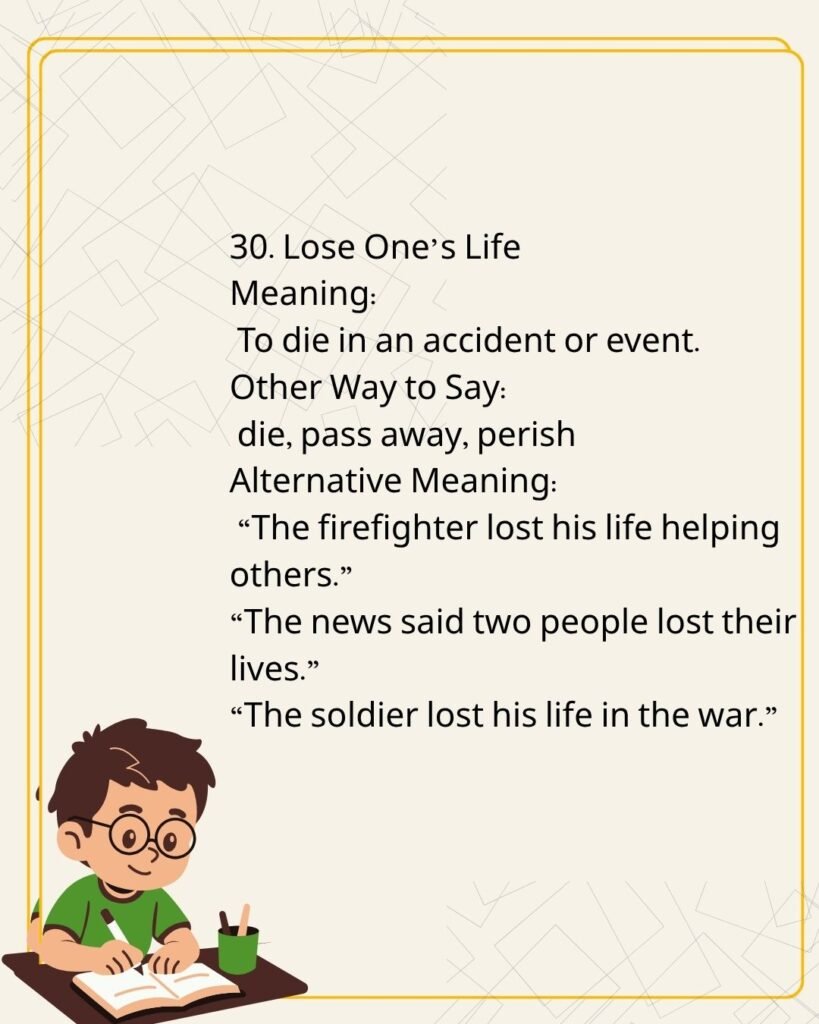
Meaning:
To die in an accident or event.
Other Way to Say:
die, pass away, perish
Alternative Meaning:
“The firefighter lost his life helping others.”
“The news said two people lost their lives.”
“The soldier lost his life in the war.”
31. Meet Death
Meaning:
To die or face death.
Other Way to Say:
die, face the end, meet one’s end
Alternative Meaning:
“The villain met death in the cave.”
“The story said the dragon met death.”
“The pirate met death at sea.”
32. Lay to Rest
Meaning:
To bury someone after death.
Other Way to Say:
bury, put in the grave, rest in peace
Alternative Meaning:
“They laid the soldier to rest.”
“The family laid their dog to rest.”
“The town laid the hero to rest.”
33. Depart This Life
Meaning:
A polite phrase for dying.
Other Way to Say:
pass away, leave life, be gone
Alternative Meaning:
“The writer departed this life at ninety.”
“The news said he departed this life.”
“The old teacher departed this life last year.”
34. Eternal Rest
Meaning:
The peaceful rest after death.
Other Way to Say:
rest forever, rest in peace, sleep forever
Alternative Meaning:
“The prayer asked for eternal rest.”
“The stone spoke of eternal rest.”
“The poem talked about eternal rest.”
35. Gone for Good
Meaning:
Someone has died and will not return.
Other Way to Say:
gone forever, passed away, no longer here
Alternative Meaning:
“Our old dog is gone for good.”
“The hero is gone for good in the story.”
“The singer is gone for good.”
36. Last Moments
Meaning:
The final time before a person dies.
Other Way to Say:
final time, last breath, end of life
Alternative Meaning:
“The family stayed in his last moments.”
“The story showed the king’s last moments.”
“The hero spoke in his last moments.”
37. Fade Away
Meaning:
To slowly die or disappear from life.
Other Way to Say:
pass away slowly, slip away, die
Alternative Meaning:
“The old dog faded away.”
“The story said the hero faded away.”
“The man faded away in peace.”
38. Slip Away
Meaning:
To die in a quiet way.
Other Way to Say:
pass away quietly, fade away, die gently
Alternative Meaning:
“She slipped away in the night.”
“The old man slipped away at home.”
“The story said the hero slipped away.”
39. The End of the Road
Meaning:
The final point of life.
Other Way to Say:
end of life, last stage, final time
Alternative Meaning:
“The cowboy reached the end of the road.”
“The story said the hero met the end of the road.”
“The old man knew it was the end of the road.”
40. Gone Too Soon
Meaning:
A person died at a young age.
Other Way to Say:
died young, left early, passed away young
Alternative Meaning:
“The singer was gone too soon.”
“The team said the player was gone too soon.”
“Our neighbor’s son was gone too soon.”
41. Pay the Ultimate Price
Meaning:
To die while helping or serving others.
Other Way to Say:
lose one’s life, die in service, give life
Alternative Meaning:
“The soldier paid the ultimate price.”
“The officer paid the ultimate price.”
“The hero paid the ultimate price.”
42. Leave the Living
Meaning:
To die and leave the living world.
Other Way to Say:
pass away, leave life, depart
Alternative Meaning:
“The king left the living in the story.”
“The hero left the living after the fight.”
“The old ruler left the living.”
43. Silent Sleep
Meaning:
A calm way to talk about death.
Other Way to Say:
eternal sleep, rest forever, deep rest
Alternative Meaning:
“The poem spoke of silent sleep.”
“The hero fell into silent sleep.”
“The stone talked about silent sleep.”
44. Close One’s Eyes Forever
Meaning:
To die and never wake again.
Other Way to Say:
die, pass away, sleep forever
Alternative Meaning:
“The old king closed his eyes forever.”
“The story said the hero closed his eyes forever.”
“The man closed his eyes forever at home.”
45. Leave the Earth
Meaning:
To die and no longer live on Earth.
Other Way to Say:
pass away, depart life, leave this world
Alternative Meaning:
“The singer left the Earth last year.”
“The hero left the Earth at the end.”
“The old teacher left the Earth.”
46. Go Silent
Meaning:
To die and become quiet forever.
Other Way to Say:
pass away, fall silent, leave life
Alternative Meaning:
“The hero went silent in the story.”
“The old man went silent at night.”
“The king went silent after the battle.”
47. Final Journey
Meaning:
The last path a person takes after death.
Other Way to Say:
last trip, final path, last ride
Alternative Meaning:
“The town spoke of his final journey.”
“The story showed the hero’s final journey.”
“The family talked about the final journey.”
48. Long Sleep
Meaning:
A soft phrase for death.
Other Way to Say:
eternal sleep, rest forever, silent sleep
Alternative Meaning:
“The poem said he took a long sleep.”
“The hero went into a long sleep.”
“The king took a long sleep.”
49. Go Into the Light
Meaning:
To die and move into peace.
Other Way to Say:
pass away, go to heaven, leave life
Alternative Meaning:
“The story said the hero went into the light.”
“The nurse said he went into the light.”
“The movie said the king went into the light.”
50. Lay Down One’s Life
Meaning:
To die while helping others.
Other Way to Say:
give life, sacrifice life, lose life
Alternative Meaning:
“The firefighter laid down his life.”
“The soldier laid down his life.”
“The hero laid down his life for the town.”
51. Go Quietly
Meaning:
To die in a calm way.
Other Way to Say:
pass peacefully, slip away, fade away
Alternative Meaning:
“The old dog went quietly.”
“Grandpa went quietly at home.”
“The hero went quietly at the end.”
52. Leave the Body
Meaning:
A phrase some people use for death.
Other Way to Say:
pass away, depart life, die
Alternative Meaning:
“The story said the spirit left the body.”
“The hero left the body in the tale.”
“The old man left the body peacefully.”
53. Be at Rest
Meaning:
A calm state after death.
Other Way to Say:
rest in peace, eternal rest, sleep forever
Alternative Meaning:
“The stone said he is at rest.”
“Mom said Grandpa is at rest.”
“The poem said the hero is at rest.”
54. Gone from Sight
Meaning:
A person has died and is no longer seen.
Other Way to Say:
passed away, gone, not here anymore
Alternative Meaning:
“The hero is gone from sight.”
“The singer is gone from sight.”
“Our old dog is gone from sight.”
55. End One’s Days
Meaning:
To die after living life.
Other Way to Say:
die, pass away, meet the end
Alternative Meaning:
“The king ended his days in peace.”
“The old cowboy ended his days at home.”
“The hero ended his days with honor.”
56. The Final Breath
Meaning:
The last breath before death.
Other Way to Say:
last breath, final moment, end of life
Alternative Meaning:
“The doctor spoke about his final breath.”
“The story told of the king’s final breath.”
“The hero took his final breath.”
57. Go to Rest
Meaning:
A gentle phrase for death.
Other Way to Say:
rest in peace, sleep forever, pass away
Alternative Meaning:
“Our dog went to rest.”
“Grandpa went to rest last winter.”
“The hero went to rest in the story.”
58. Return to Dust
Meaning:
A phrase that means the body returns to the earth.
Other Way to Say:
be buried, die, go to the grave
Alternative Meaning:
“The poem said we return to dust.”
“The king returned to dust.”
“The story said the hero returned to dust.”
59. Leave the Land of the Living
Meaning:
To die and leave the living world.
Other Way to Say:
pass away, depart life, leave this world
Alternative Meaning:
“The pirate left the land of the living.”
“The hero left the land of the living.”
“The king left the land of the living.”
60. Be Taken Away
Meaning:
A gentle phrase for death.
Other Way to Say:
pass away, leave life, be gone
Alternative Meaning:
“The old man was taken away in sleep.”
“The story said the hero was taken away.”
“The singer was taken away last year.”
61. Go Home to God
Meaning:
A phrase people use for death in faith.
Other Way to Say:
go to heaven, be with God, pass away
Alternative Meaning:
“The pastor said she went home to God.”
“Grandma went home to God.”
“The story said the hero went home to God.”
62. The Last Goodbye
Meaning:
The final farewell before burial.
Other Way to Say:
final farewell, last goodbye, final parting
Alternative Meaning:
“The family said the last goodbye.”
“The town came for the last goodbye.”
“The story ended with the last goodbye.”
Fill in the Blanks: “Death Idioms and Expressions”
Fill in each blank with the correct phrase.
- My grandpa was very sick last year, and the doctor said he was at ______ door.
- Our old dog was very tired and ______ away at home last night.
- The news said the brave firefighter ______ his life while helping people.
- My teacher told the class that the famous writer is ______ with us.
- Many people wrote “______ in peace” on the card for the family.
- My neighbor said her grandmother ______ away last winter.
- The news said the soldier ______ the ultimate price while serving the country.
- My uncle said his old friend ______ this world last month.
- The pastor said our neighbor has ______ home to God.
- The family gathered to say the ______ goodbye at the funeral.
- The nurse told the family that the man took his ______ breath early in the morning.
- My mom said our old cat has ______ to a better place.
- The teacher told us the old coach is gone but not ______.
- The doctor said the patient ______ away peacefully during the night.
- The newspaper said two people ______ their lives in the accident.
- My aunt said her friend ______ quietly at home.
- The pastor said the kind woman is now ______ at rest.
- My neighbor said her father was ______ home last Sunday.
- The family met to ______ their grandmother to rest.
- The news said the old actor ______ this life at age ninety.
Answers
- death’s
- slipped
- lost
- no longer
- rest
- passed
- paid
- left
- gone
- last
- last
- gone
- forgotten
- passed
- lost
- went
- at
- called
- lay
- departed
Conclusion
Death is a hard topic for many people. So people often use soft words when they talk about it. These words are called idioms and expressions. They help people speak with care. Phrases like “pass away” or “rest in peace” sound calm and kind. They can make sad news easier to say and hear.
Learning these phrases can help us understand books, news, and daily talk in the United States. You may hear them at home, at school, or in the news. When we know their meaning, we can understand others better. We can also speak in a gentle way when we talk about someone who has died. These small phrases help people share respect and care.